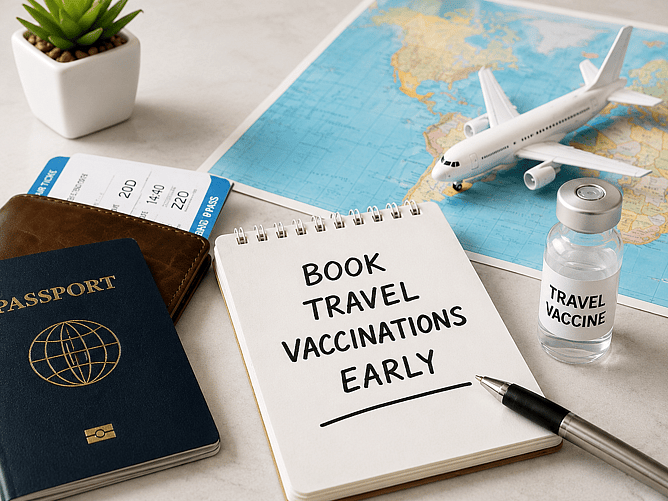
Most people think about travel vaccinations too late. They book flights, arrange accommodation, sort visas, and then, a week before departure, remember they might need a jab or two. That rush is avoidable, and it can put your health at real risk.
At Sumner Pharmacy, we see this pattern regularly. The good news is, with a little planning, getting your travel immunizations sorted is straightforward.
Key Takeaways
Book your travel vaccination appointment at least 6 to 8 weeks before departure.
Some vaccines require multiple doses spread over weeks or months.
Your destination, travel style, and personal health history all affect what you need.
A travel vaccination clinic in Christchurch can provide destination-specific travel health advice in a single consultation.
Leaving it too late may mean incomplete protection or missing out on certain vaccines entirely.
Why Timing Matters With Travel Vaccinations
The short answer: Your immune system needs time to respond to vaccines. Book too late, and you may not be fully protected by the time you board.
Some travel vaccinations are a one-and-done deal. Others, like the hepatitis B series or the Japanese encephalitis vaccine, require two or three doses given weeks apart. If you show up two weeks before your flight, you simply can not complete those courses in time.
Beyond multi-dose vaccines, your body needs time to build immunity after any shot. Most vaccines take 1 to 4 weeks to reach full effectiveness. A few, like the rabies pre-exposure course, need even longer.
Timing is not just a formality. It is the difference between protected and exposed.
The General Rule: Book 6 to 8 Weeks Out
For most destinations, booking your travel vaccinations 6 to 8 weeks before you leave gives you enough time to
Complete multi-dose vaccine courses
Allow immunity to develop fully
Get a malaria prescription if needed (some require a lead-up period)
Address any reactions before you travel
That said, 6 to 8 weeks is the minimum, not the ideal. If you are traveling to higher-risk regions like sub-Saharan Africa, Southeast Asia, or parts of South America, aim for 3 months out.
What If You Are Traveling Sooner?
Do not skip the appointment just because you are short on time. Even if you are leaving in two weeks, some protection is better than none.
Our team at Sumner Pharmacy can assess what vaccines are still viable given your timeline. In some cases, an accelerated schedule is possible. In others, we can prioritize the most critical vaccines for your specific destination.
Come in anyway. We will work with what time you have.
Which Vaccines Take the Longest?
Some travel immunizations need the most lead time. Here is a quick breakdown:
Hepatitis B: Three doses over 6 months (standard) or an accelerated schedule over 3 weeks with a booster at 12 months.
Japanese Encephalitis: Two doses, 28 days apart. Protection starts 1 week after the second dose.
Rabies (Pre-Exposure): Three doses over 21 to 28 days. If you are heading into remote areas where medical care is limited, this is worth planning well in advance.
Typhoid (Oral): Four capsules are taken every other day over a week, so not technically a long course, but you need to pick up the prescription before travel and store it correctly.
Yellow Fever: A single dose, but it must be given at least 10 days before arrival in a country that requires proof. Some countries will deny entry without a valid International Certificate of Vaccination.
Do You Need the Same Vaccines Every Trip?
No. Your travel immunizations depend on several factors, including:
Where you are going (region, country, urban vs. rural)
How long you are staying
Your activities (hiking, swimming in fresh water, working with animals)
Your vaccination history
Your age and health status
A two-week beach holiday in Bali needs a different plan than three months backpacking through rural Cambodia. That is why a proper travel health consultation matters. It is not just a quick tick-box exercise.
What Happens at a Travel Vaccination Consultation?
At our travel vaccination clinic in Christchurch, your consultation covers:
Destination risk assessment based on current disease activity and alerts
Review of your vaccination history to avoid duplicate doses
Recommended vaccines for your specific itinerary and travel style
Malaria and other preventive medications if relevant
General travel health advice on food safety, insect precautions, and what to do if you get sick overseas
We take the time to understand your trip properly. That means you leave with a plan that is actually relevant to where you are going, not a generic list.
Staying Up to Date: Boosters and Previous Vaccines
Some vaccines you received years ago may need a booster. Tetanus and diphtheria are common examples. Others, like hepatitis A, offer long-term or lifelong immunity after a two-dose course.
Bring any records you have of previous vaccinations. If you do not have them, we can work with what you remember and check against standard schedules.
Even if you have traveled before, do not assume your previous vaccines still cover you. Requirements and recommendations change, and disease activity shifts.
Routine Vaccines Are Part of Travel Health Too
Travel vaccinations are not only exotic or destination-specific shots. Before thinking about yellow fever or Japanese encephalitis, we check that your routine vaccinations are current.
MMR (measles, mumps, rubella), tetanus, diphtheria, and flu are often overlooked in travel planning. Measles outbreaks, in particular, have occurred in popular travel destinations in recent years. Being up-to-date on routine immunizations is a basic but important part of travel health advice.
Can Children and Pregnant Travelers Get Travel Vaccinations?
Children: Yes, most travel vaccines are suitable for children, though age minimums vary. We can advise based on your child's age and destination.
Pregnant travelers: Some vaccines are not recommended during pregnancy (live vaccines in particular). Others are safe and may be recommended if the risk of disease is high. We assess this case by case.
If you are pregnant or traveling with young children, mention this when you book. It affects which vaccines and medications are appropriate.
Travel Vaccinations and Travel Insurance
A few points worth knowing:
Some travel insurance policies require you to have recommended vaccinations for your destination. Skipping them could affect a claim.
If you become ill from a vaccine-preventable disease because you did not get vaccinated, your insurer may not cover related medical costs.
It is worth checking your policy before you travel.
Book Your Travel Vaccination Appointment in Christchurch
Sumner Pharmacy provides travel health consultations for travelers heading anywhere in the world. Whether you are planning a short holiday or a long-haul expedition, our team can help you travel with confidence.
We stock a wide range of travel vaccines and can advise on malaria prevention, traveler's diarrhea, and destination-specific risks.
Visit us at Sumner Pharmacy or contact us to book your travel health appointment today.
Frequently Asked Questions
How far in advance should I get travel vaccinations?
Ideally, 6 to 8 weeks before departure. For high-risk destinations or vaccines requiring multiple doses, 3 months is better. If you are leaving sooner, still book an appointment, as partial protection is better than none.
Can I get travel vaccinations at the last minute?
Yes, though your options narrow. Some vaccines can not be completed in time, but others can still be given and will provide some protection. Visit our travel vaccination clinic in Christchurch, and we will work with your timeline.
Do I need a prescription for travel vaccinations?
Some travel medications, like antimalarials, require a prescription. Vaccines themselves are administered by our pharmacists or under prescriber oversight. Book a consultation and we will handle the paperwork.
Are travel vaccinations covered by New Zealand health funding?
Most travel vaccines are not publicly funded and are paid for privately. Some routine vaccines (like flu) may be funded depending on your eligibility. We can clarify costs at your consultation.
How long do travel vaccinations last?
It varies by vaccine. Hepatitis A provides long-term protection after two doses (up to 25 years or more). Yellow fever is considered lifelong after one dose. Tetanus needs a booster every 10 years. We will review what you need during your appointment.